神戸の婦人科・産婦人科|女医|中絶手術・アフターピル・ピル

神戸の婦人科・産婦人科|女医|中絶手術・アフターピル・ピル
Sannomiya Ekimae Ladies Clinic is a gynecology (OB/GYN) clinic in Kobe’s Sannomiya area. We offer testing for sexually transmitted infections (STIs), also known as STDs, including chlamydia, gonorrhea, syphilis, and HIV. Whether you have symptoms, a partner has tested positive, or you would like a checkup, we can discuss suitable tests. Same-day testing visits and appointments with your partner are available; result times vary by test.
目次
“My vaginal discharge seems different…”
“I’m worried I might have an STI, but I feel nervous about seeing a gynecologist…”
“My partner has tested positive for an STI…”
Do any of these concerns sound familiar?
STIs can develop with few or no noticeable symptoms.
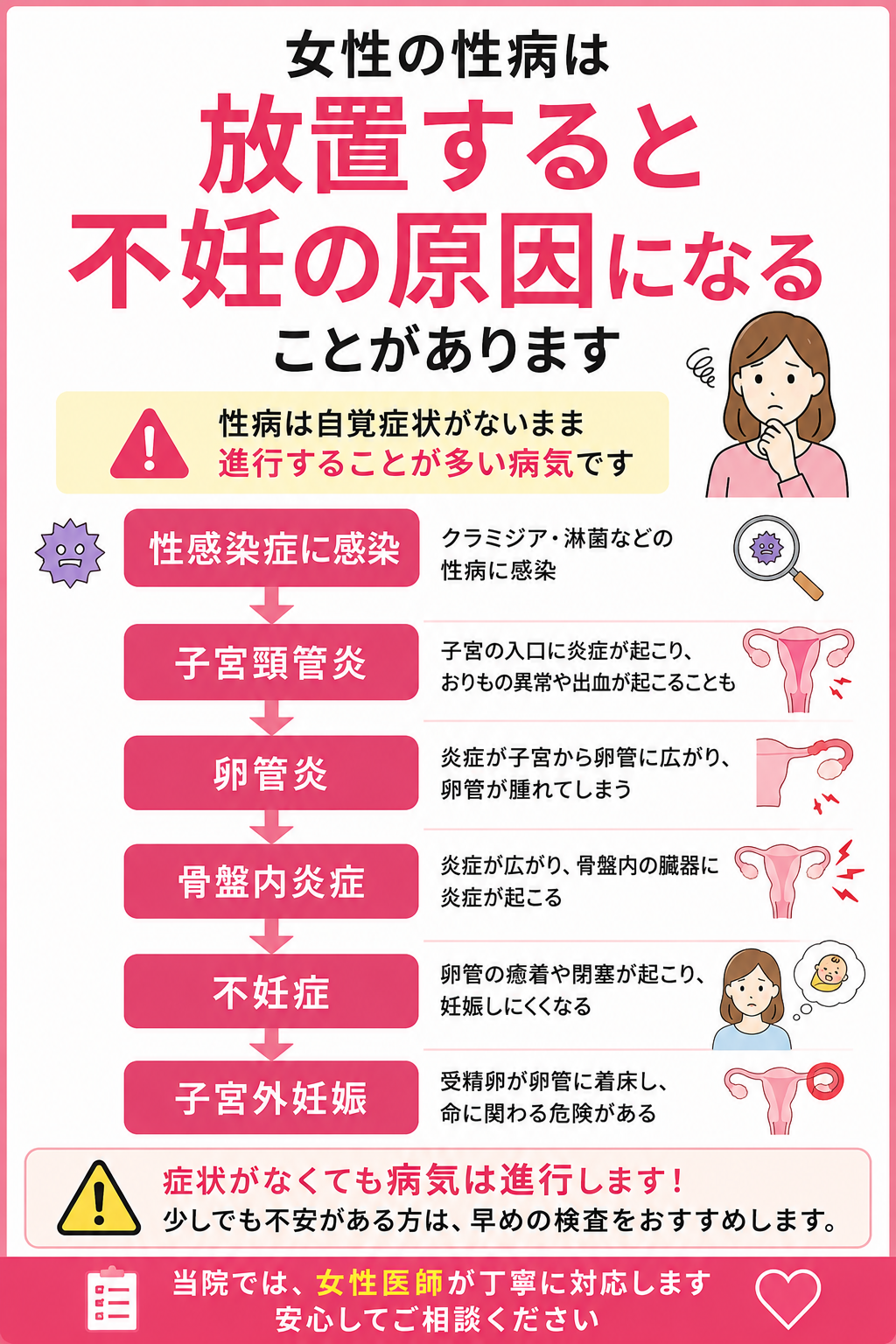
Women in particular may have no symptoms. Without realizing it, they may pass an infection to a partner or develop complications that affect fertility or increase the risk of ectopic pregnancy.
We offer testing for a wide range of STIs, including chlamydia, gonorrhea, syphilis, HIV and genital herpes.
Female doctors provide care with respect for your privacy. You are welcome to talk with us, even if this is your first gynecology appointment.
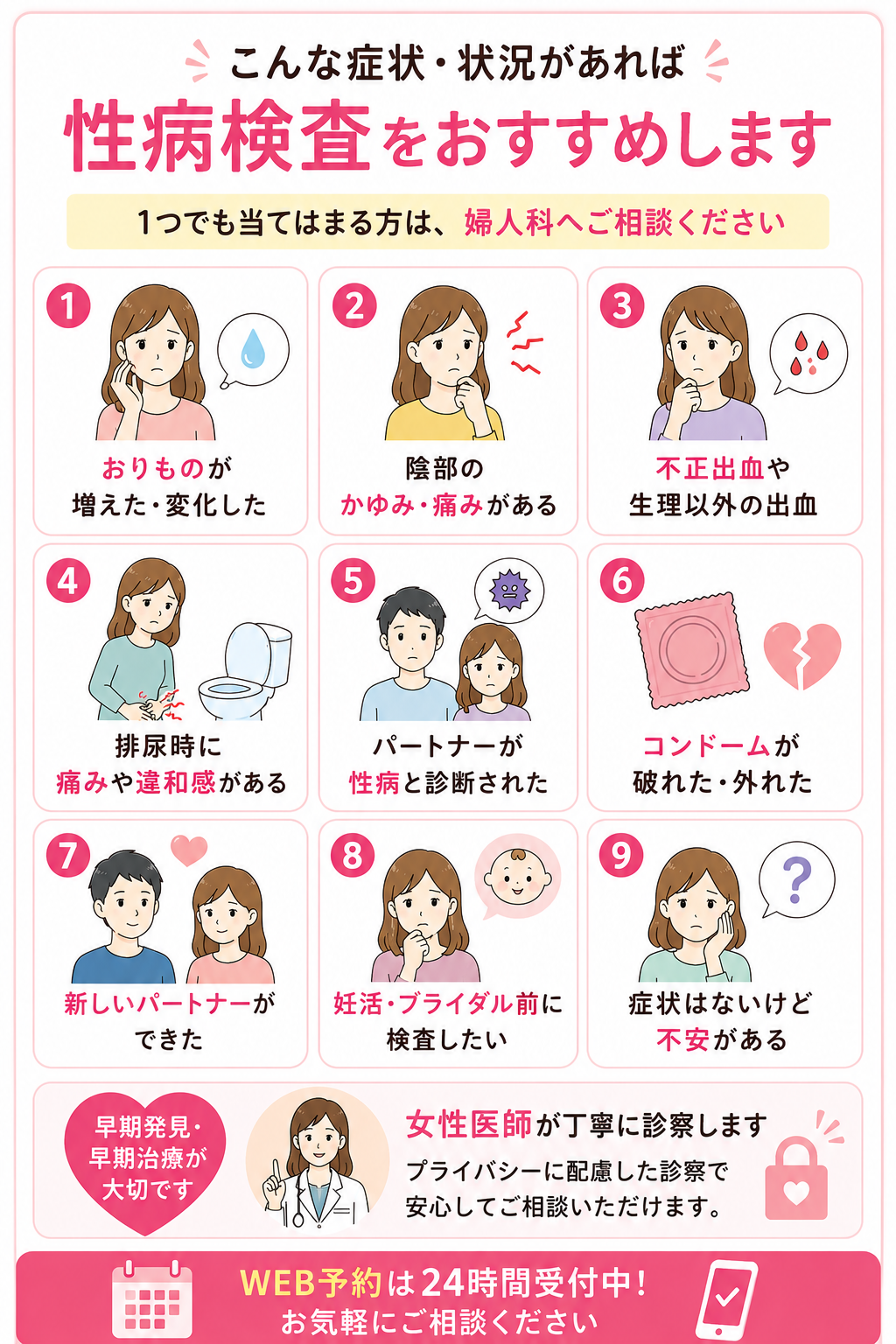
□ Increased vaginal discharge
□ Genital itching or pain
□ Bleeding after sex
□ A partner has been diagnosed with an STI
□ A condom broke during sex
□ Sex with casual partners
□ A new sexual partner
□ Testing before marriage or trying for a baby
□ Worries about infection, even without symptoms
If any of these apply to you, we recommend discussing STI testing with us.
Sexually transmitted infections (STIs), also called sexually transmitted diseases (STDs), are infections passed from one person to another through sexual contact.
They can be transmitted through:
These are common routes of transmission.
There is sometimes a misconception that STIs only affect certain people. In fact, anyone who is sexually active can acquire an STI.
In recent years, Japan has seen concern over infections such as:
These infections remain an important public health concern.
Infections among women in their 20s and 30s are a particular concern.
STIs in women frequently cause no noticeable symptoms.
More than half of women with chlamydia are reported to have no symptoms.
An infection can still progress even when there are no symptoms.
Possible complications of untreated infection include:
These complications may occur even without obvious initial symptoms.
Having no symptoms does not necessarily mean you are free of infection. If you are concerned, we recommend testing.
Possible causes
Possible causes
Possible causes
Possible causes
Possible causes
Chlamydia is one of the most common STIs in Japan.
Common symptoms
Untreated infection can increase the risk of:
These are potential complications of untreated infection.
Common symptoms
Gonorrhea can also infect the throat.
Syphilis infections among women have increased sharply in recent years.
Common symptoms
There may also be periods without symptoms.
Early symptoms
HIV can remain without noticeable symptoms for a long time, so testing is important.
Common symptoms
Symptoms may recur.
Common symptoms
Genital warts are caused by human papillomavirus (HPV).
Common symptoms
Vaginal thrush is not usually considered an STI, but its symptoms can be mistaken for one.
These organisms have received increasing attention in sexual health care.
They may be associated with persistent symptoms.
How soon can I get tested? A guide to testing windows
STIs cannot always be detected immediately after exposure. The appropriate testing window depends on the infection and the type of test used.
• Testing may be offered from around 24 hours after sex; an early negative result may require repeat testing.
• If you have symptoms such as pain when urinating or unusual discharge, seek medical advice promptly.
• General testing guide: from 4 weeks after possible exposure.
• Some antibody tests may be offered from around 4 weeks after possible exposure; the appropriate timing depends on the test.
• Follow-up testing at 3 months or later may be recommended to confirm a negative result, depending on the test used.
• General testing guide: around 4–6 weeks after possible exposure.
• Follow-up testing at 3 months or later may be recommended to confirm a negative result, depending on the test used.
• Antibodies take time to develop, so a test may be negative in the early stages of infection.
• General testing guide: around 2–3 months after possible exposure.
• The time needed for a virus or antibodies to become detectable varies, so testing at the appropriate time is important.
• A condom broke during sex
• Your partner has been diagnosed with an STI
• You have had sex with casual partners
• You have taken emergency contraception
• You have experienced sexual assault
If you are unsure when to get tested, please contact us for advice.
• Chlamydia
• Gonorrhea
• Trichomoniasis
• Vaginal thrush (candidiasis)
• Bacterial vaginosis
• Syphilis
• HIV
• Hepatitis B
• Hepatitis C
• Throat chlamydia
• Throat gonorrhea
• Chlamydia
• Gonorrhea
Testing is also recommended for people planning to marry or trying to conceive.
Some STIs can affect fertility or increase the risk of miscarriage.
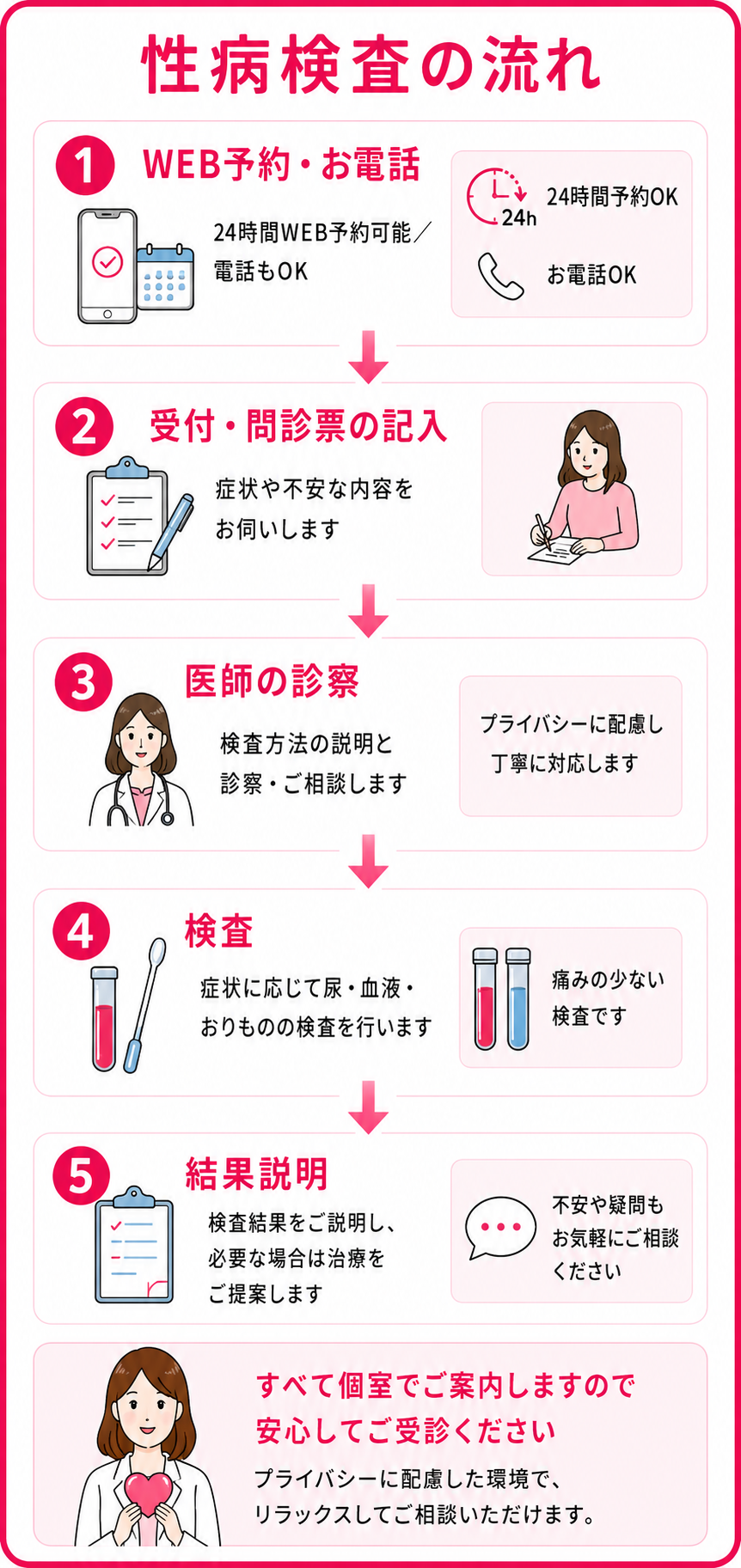
Online booking is available 24 hours a day.
We will ask about your symptoms and relevant sexual history.
A female doctor will provide a careful, considerate consultation.
Depending on the tests you need, we may collect:
• A vaginal swab
• A urine sample
• A blood sample
Your doctor will explain the samples required.
We will explain your test results.
Treatment will be started if needed.
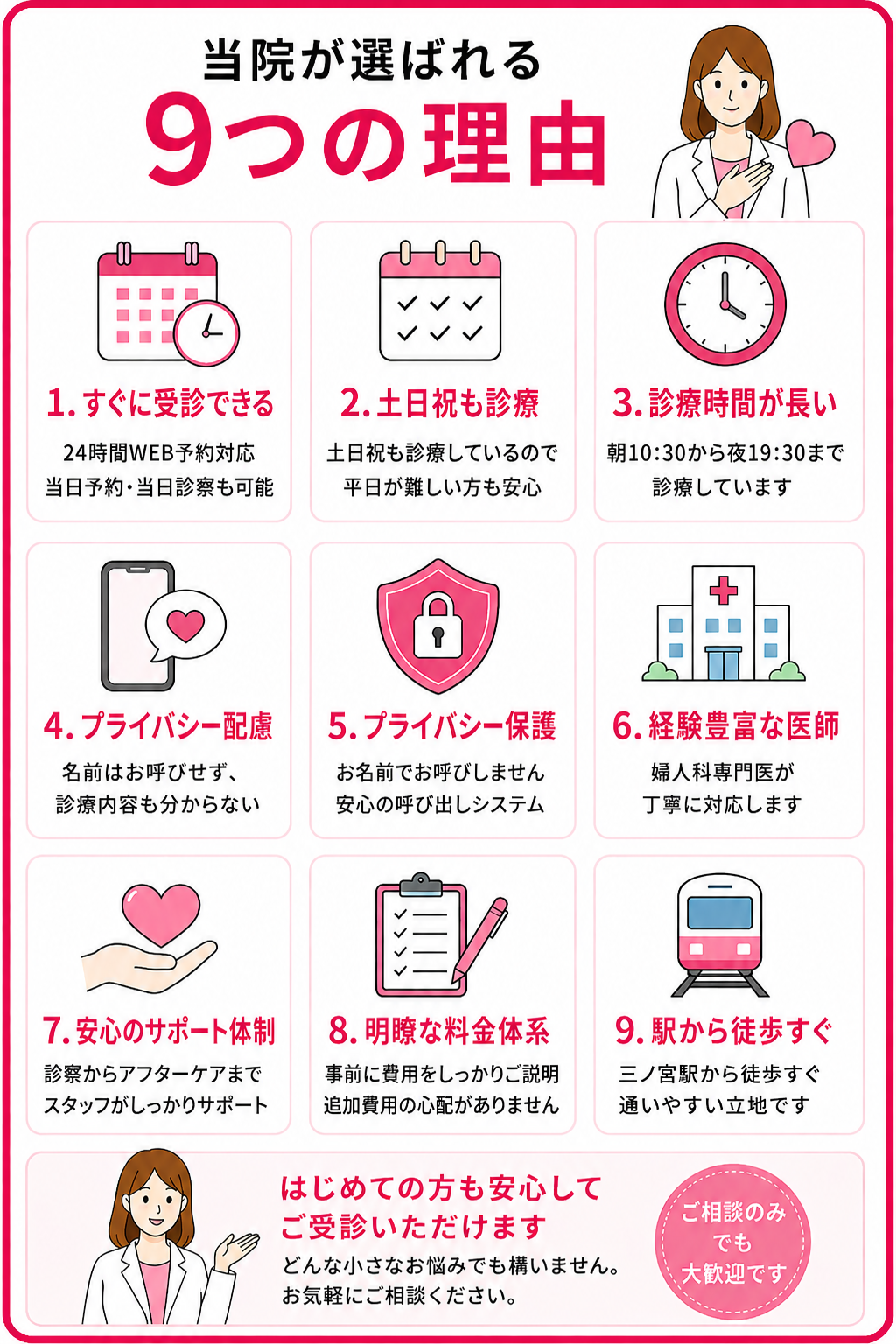
You are welcome to discuss your concerns, even if this is your first gynecology visit.
Our convenient location makes it easier to attend appointments.
We offer convenient appointments for people who are busy during the week.
If you have symptoms, we recommend seeking care promptly.
We take your privacy seriously.
Some concerns can also be discussed through an online consultation.
You may attend together with your partner.
| Test | Method and Preparation |
|---|---|
| Genital (vaginal) chlamydia and gonorrhea | Vaginal swab tested using transcription-mediated amplification (TMA). Same-day results available, in as little as approximately 40 minutes. |
| Throat chlamydia and gonorrhea | TMA testing using a gargle sample. Do not eat, drink or brush your teeth for 1 hour before the test. |
| Syphilis and HIV (blood tests) | Blood testing. Same-day results available, in as little as approximately 80 minutes. |
*Same-day results are not available for throat tests.
If work or school makes it difficult to visit, or if you would prefer greater privacy,our at-home STI test kits let you collect your samples at homeand send them to the laboratory for testing.
Anonymous orders are also available. Testing options include:Chlamydia•Gonorrhea•Syphilis• HIV, hepatitis B and hepatitis CA range of STI testing options is available.
At-home testing may suit you if you are worried about infection despite having no symptoms, want to test together with your partner, or feel uncomfortable visiting a gynecology clinic.
We offer bothin-clinic STI testingwith a medical consultation and convenientat-home STI testing by mail. Choose the option that best suits your needs and lifestyle.
STIs often cause no noticeable symptoms. Even if you feel well, an infection may be passed to a partner without your knowledge. Left untreated, some infections can lead to serious complications, including infertility and ectopic pregnancy.
At Sannomiya Ekimae Ladies Clinic, we tailor STI testing to each patient’s needs.
| Women | Consultation + Candida test + bacterial culture + Trichomoniasis |
|---|---|
| Men | Consultation + trichomoniasis test |
Start with the basic package, then add the teststhat suit your concerns to create a personalized screening package.
| Throat chlamydia | ¥3,900 |
|---|---|
| Throat gonorrhea | ¥3,900 |
*Do not eat, drink or brush your teeth for 1 hour before a throat test.
| Vaginal chlamydia | ¥3,900 |
|---|---|
| Vaginal gonorrhea | ¥3,900 |
| Mycoplasma + Ureaplasma | ¥9,800 |
| Chlamydia in men (urine) | ¥3,900 |
|---|---|
| Gonorrhea in men (urine) | ¥3,900 |
| Vaginal chlamydia (Results in as little as approximately 40 minutes) | ¥5,900 |
|---|---|
| Vaginal gonorrhea (Results in as little as approximately 40 minutes) | ¥5,900 |
| Syphilis (Results in as little as approximately 80 minutes) | ¥5,900 |
| HIV (Results in as little as approximately 80 minutes) | ¥6,500 |
| Hepatitis B + hepatitis C | ¥3,900 |
|---|---|
| Syphilis | ¥3,900 |
| HIV | ¥4,500 |
Testing may be covered by Japanese health insurance if you have symptoms or your doctor determines that it is medically necessary.
Testing may be offered on a self-pay basis if you have no symptoms or request screening only.
If one partner remains untreated, an STI can be passed back and forth. We also offer testing for male partners, including chlamydia, gonorrhea, syphilis, HIV and Mycoplasma. Men must attend with their partner; appointments for men attending alone are not available.
Getting tested and treated together is an important step toward preventing reinfection.
Yes. STI testing can be worthwhile even if you have no symptoms.
Many STIs can develop with few or no noticeable symptoms. Chlamydia, gonorrhea and syphilis in particular may cause no obvious symptoms in women.
Assuming that everything is fine because you have no pain or changes in discharge can allow an infection to progress unnoticed. Some infections can cause inflammation of the fallopian tubes or pelvic inflammatory disease, increasing the risk of infertility and ectopic pregnancy.
You may also pass an infection to your partner without having symptoms yourself.
Consider testing even without symptoms if:
• You have a new sexual partner
• Your partner has been diagnosed with an STI
• A condom broke during sex
• You have had sex without protection
• You are planning a pregnancy or getting married
• You have had an STI in the past
If you are considering STI testing in Kobe–Sannomiya, please contact us whether or not you have symptoms.
Symptoms vary depending on the infection.
Possible symptoms include:
• Increased vaginal discharge
• Changes in the color or smell of discharge
• Genital itching or pain
• Pain during sex
• Pain when urinating
• Lower abdominal pain
• Abnormal vaginal bleeding
• Bumps or blisters
These symptoms can have a range of causes.
However, STIs do not always cause symptoms.
For example, more than half of women with chlamydia are reported to have no symptoms.
Early symptoms of syphilis or HIV may also be mild and go unnoticed.
An infection may progress while you wait to see whether a minor symptom improves. If you are concerned, it is important to see a gynecologist promptly.
It is understandable to worry that STI testing might be painful or embarrassing.
Most tests are quick and do not cause severe pain.
For a vaginal swab, a small amount of discharge is collected using a swab. Collection usually takes only a few seconds.
A blood test involves a routine blood draw.
A urine test simply requires you to provide a urine sample and causes very little physical discomfort.
We explain each step carefully and respect your privacy to help you feel at ease, especially if this is your first gynecology visit.
Please tell your doctor if you feel anxious about testing.
The time needed for results depends on the test.
Typical turnaround times are:
• Chlamydia and gonorrhea: a few days
• Syphilis: a few days to around 1 week
• HIV: a few days to around 1 week
• Hepatitis B and C: a few days to around 1 week
These are general estimates.
Some tests have same-day results.
If your result is positive, we will explain the treatment or further testing you may need.
Waiting for results can feel stressful, but early detection and treatment are important.
Some people hope an STI will clear up on its own, but leaving an infection untreated can lead to serious health problems.
In women, possible complications include:
• Cervicitis
• Salpingitis
• Pelvic inflammatory disease (PID)
• Infertility
• Ectopic pregnancy
These are potential complications of untreated infection.
Syphilis can affect organs throughout the body, while HIV damages the immune system.
Do not assume that mild symptoms mean there is no problem. If you are worried, please see a gynecologist as soon as possible.
Some STI tests may be covered by Japanese health insurance, while others are offered on a self-pay basis.
In general,if you have symptoms such as unusual discharge, genital itching, abnormal bleeding, painful urination or lower abdominal pain, and your doctor considers testing medically necessary,Japanese health insurance may cover the test.
By contrast, screening for reasons such as the following may be self-pay:
• You have no symptoms but would like reassurance
• You have a new partner and would like testing
• You would like testing as part of a pre-marital health check
• You want to check whether you have an STI
These circumstances may fall outside insurance coverage.
Available tests and fees may differ between insurance-covered and self-pay care. We will discuss your symptoms and preferences and recommend appropriate testing.
Some people worry about family or friends finding out, or feel anxious about attending a clinic.
Anonymous testing may be available for certain self-pay tests.
Insurance-covered care requires proof of Japanese health insurance eligibility, so fully anonymous care may not be possible.
As understanding of STIs has improved, more people have been choosing regular screening.
STIs can affect anyone. Please seek advice rather than living with uncertainty.
Yes. Depending on your situation, we recommend that your partner also be tested, because infections can be passed back and forth between partners.
With chlamydia or gonorrhea, treating only one partner may lead to reinfection if the other partner still has the infection.
For this reason, if:
• Your partner has been diagnosed with an STI
• You have been diagnosed with an STI
• You have symptoms
please ask us about testing and treatment for your partner as well.
Working together on treatment is important.
Condoms greatly reduce the risk of STIs, but they do not provide complete protection.
In particular, infections such as:
• Genital herpes
• Syphilis
• HPV (human papillomavirus)
can be transmitted through contact with areas that a condom does not cover.
The risk is also higher if a condom is put on partway through sex, breaks or slips off.
Even if you used a condom, consider testing if you have symptoms or are concerned about possible exposure.
It depends on the infection.
Chlamydia, gonorrhea and trichomoniasis can usually be cured with appropriate treatment.
However, infections such as:
• Genital herpes
• HPV infection
may persist in the body, and symptoms may recur.
Stopping treatment early can leave an infection present even after symptoms improve.
It is important to complete treatment as directed by your doctor.
For women, we recommend seeing a gynecologist.
Gynecology clinics can offer tests such as:
• A vaginal swab
• Chlamydia testing
• Gonorrhea testing
• Syphilis testing
• HIV testing
A range of other tests may also be available.
Symptoms such as abnormal bleeding or lower abdominal pain may have causes other than STIs, so a comprehensive gynecological assessment is important.
There is no single testing schedule that suits everyone. Consider testing if:
• You have a new sexual partner
• You have changed partners
• A condom broke during sex
• You have had sex with casual partners
Your doctor can advise you on an appropriate testing schedule.
If you have had an STI before or are trying to conceive, regular testing may also help provide reassurance.
Emergency contraception helps prevent pregnancy; it does not protect against STIs.
If contraception failed, possible infections to consider include:
• Chlamydia
• Gonorrhea
• Syphilis
• HIV
These may be transmitted during the same sexual contact.
If you are concerned about both pregnancy and STIs, please consult a gynecologist.
Yes. We recommend discussing STI testing before trying to conceive.
STIs such as chlamydia can increase the risk of infertility and ectopic pregnancy.
Some infections identified during pregnancy may also affect the baby.
Testing before pregnancy is an important part of preparing to conceive.
Yes. You can discuss STI testing as part of a pre-marital health check at our clinic.
Checking your health before marriage or pregnancy can help reduce uncertainty about the future.
In particular, infections such as:
• Chlamydia
• Syphilis
• Hepatitis B
• Hepatitis C
• HIV
These are among the tests commonly requested.
Many STIs require treatment and will not reliably clear up on their own.
Even if symptoms temporarily improve, the infection may still be present.
Leaving an infection untreated can allow it to progress and cause serious complications.
If you have concerning symptoms, seek medical care rather than relying only on over-the-counter treatments.
Yes. You can acquire an STI more than once.
Reinfection from a partner after treatment is particularly common with chlamydia and gonorrhea.
For this reason, if:
• Partner testing and treatment
• Condom use
• Regular testing
These measures help reduce the risk of reinfection.
The appropriate testing window depends on the infection.
Testing too soon after exposure can produce a negative result even if you have an infection.
As a general guide:
• Chlamydia and gonorrhea: testing may be offered within a few days; repeat testing may be needed if the first test is early
• Syphilis: around 4–6 weeks after exposure
• HIV: from 4 weeks after exposure, depending on the test
These are general estimates.
If you are unsure when to get tested, please ask us for advice.
Many people attending a gynecology clinic for the first time wonder:
“What will happen during the appointment?”
“Will I feel embarrassed?”
“Will I be judged?”
These feelings are understandable.
Our female doctors and staff provide considerate care and take time to listen to your concerns.
We also protect your privacy by avoiding calling out your name and taking care that others cannot overhear details of your care.
STIs can affect anyone.
You do not have to deal with your worries alone. Please feel welcome to talk with us.
Worried you might have an infection? You do not have to face it alone. Same-day visits are available, and no appointment is required.
At Sannomiya Ekimae Ladies Clinic, we listen to your concerns and aim to provide prompt care with as little discomfort as possible.
If you have symptoms that worry you, please contact us or visit the clinic.