神戸の婦人科・産婦人科|女医|中絶手術・アフターピル・ピル

神戸の婦人科・産婦人科|女医|中絶手術・アフターピル・ピル
Looking for a gynecology (OB/GYN) clinic in Kobe? Sannomiya Ekimae Ladies Clinic offers consultations for bleeding between periods, bleeding after sex, and bleeding after menopause. Learn about possible causes, tests, and treatment options, and when to seek medical care.
Noticed unexpected bleeding or brown discharge? Tell us when it started, how much bleeding you have, and whether you have any pain. We will discuss whether an examination, ultrasound, or other tests are needed and explain the next steps.
Bleeding between periods, brown discharge, bleeding after sex or persistent spotting can have many causes. These range from hormonal changes to conditions affecting the uterus or vagina, or causes related to pregnancy. We can discuss the examinations and tests appropriate for your symptoms.
Your doctor will determine which tests and treatments are appropriate after your consultation.
It means bleeding that differs from your usual period or occurs outside your expected period.
It can include brown or pink discharge and small spots of blood on your underwear, as well as red bleeding. Blood may come from the cervix or vagina as well as the uterus. Color and amount alone cannot identify the cause.
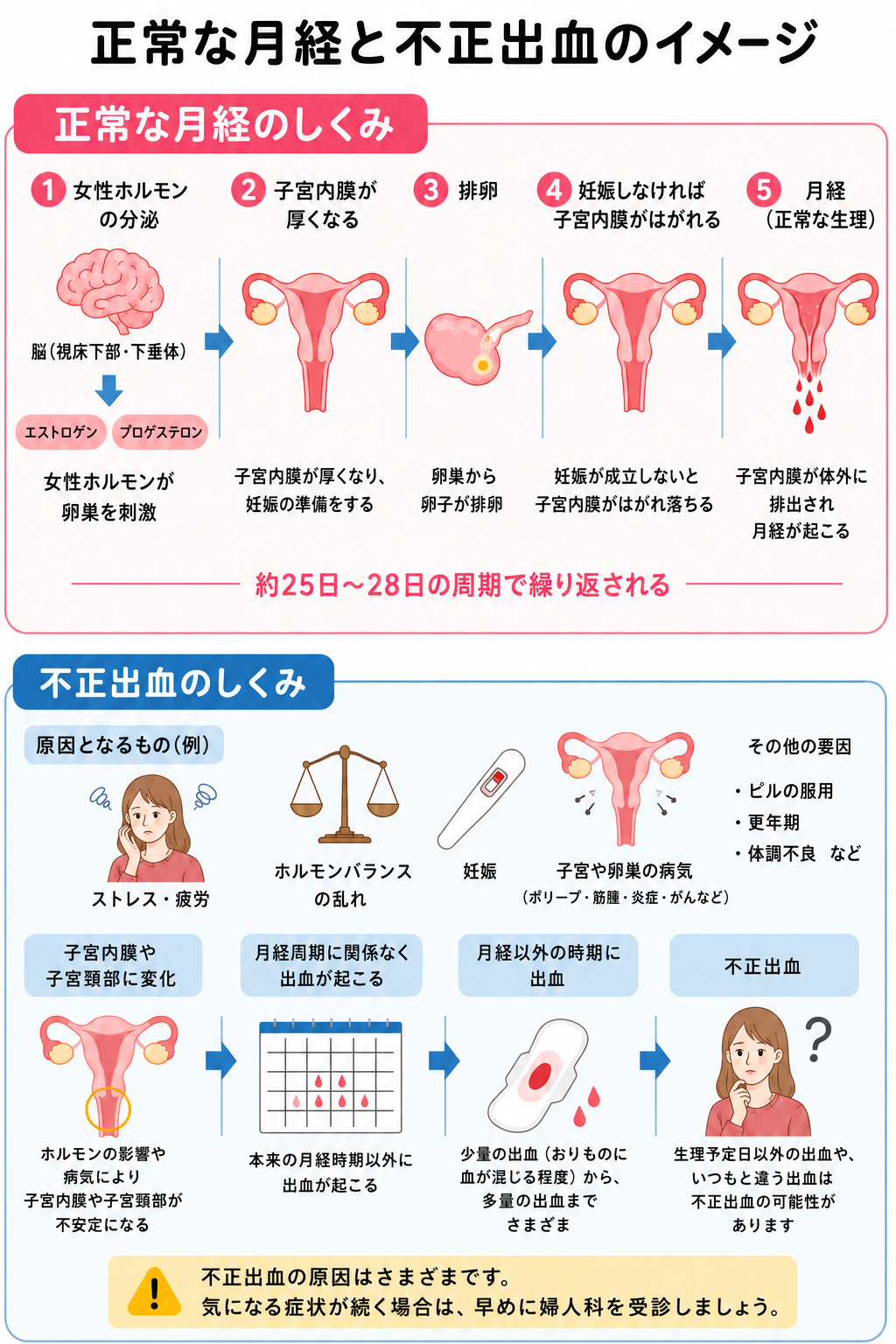
Even light bleeding can be assessed if it continues, recurs or differs from your usual pattern.
For very heavy bleeding, severe abdominal pain or feeling as though you may lose consciousness, seek emergency medical care rather than waiting for a routine online appointment. If pregnancy is possible, an ectopic pregnancy or another condition may require urgent assessment.
Similar-looking bleeding can have different causes. This table is a guide to seeking care, not a diagnosis.
| Symptom or situation | may mean | When to seek advice |
|---|---|---|
| Brown discharge or light spotting | Blood may be mixed with vaginal discharge. Possible causes include changes around ovulation, inflammation and polyps. | Seek advice if it continues or recurs. |
| Bleeding again after your period | It may seem to be the end of your period, but there may be another cause. | Seek advice if it differs from your usual period. |
| Bleeding after sex | Possible causes include inflammation of the vagina or cervix, polyps and cervical abnormalities. | Arrange an assessment if it recurs. |
| Bleeding while using a combined pill, mini-pill or Mirena | Bleeding can occur when starting these methods, but pregnancy and other causes also need consideration. | Seek advice for heavy or prolonged bleeding, or bleeding with pain. |
| Pregnancy is possible | Possible causes include bleeding in early pregnancy, miscarriage and ectopic pregnancy. | Seek medical advice promptly if you also have abdominal pain. |
| Bleeding after menopause | Possible causes include changes in the vagina or uterine lining, polyps and endometrial cancer. | See a gynecologist even if it happens only once or is very light. |
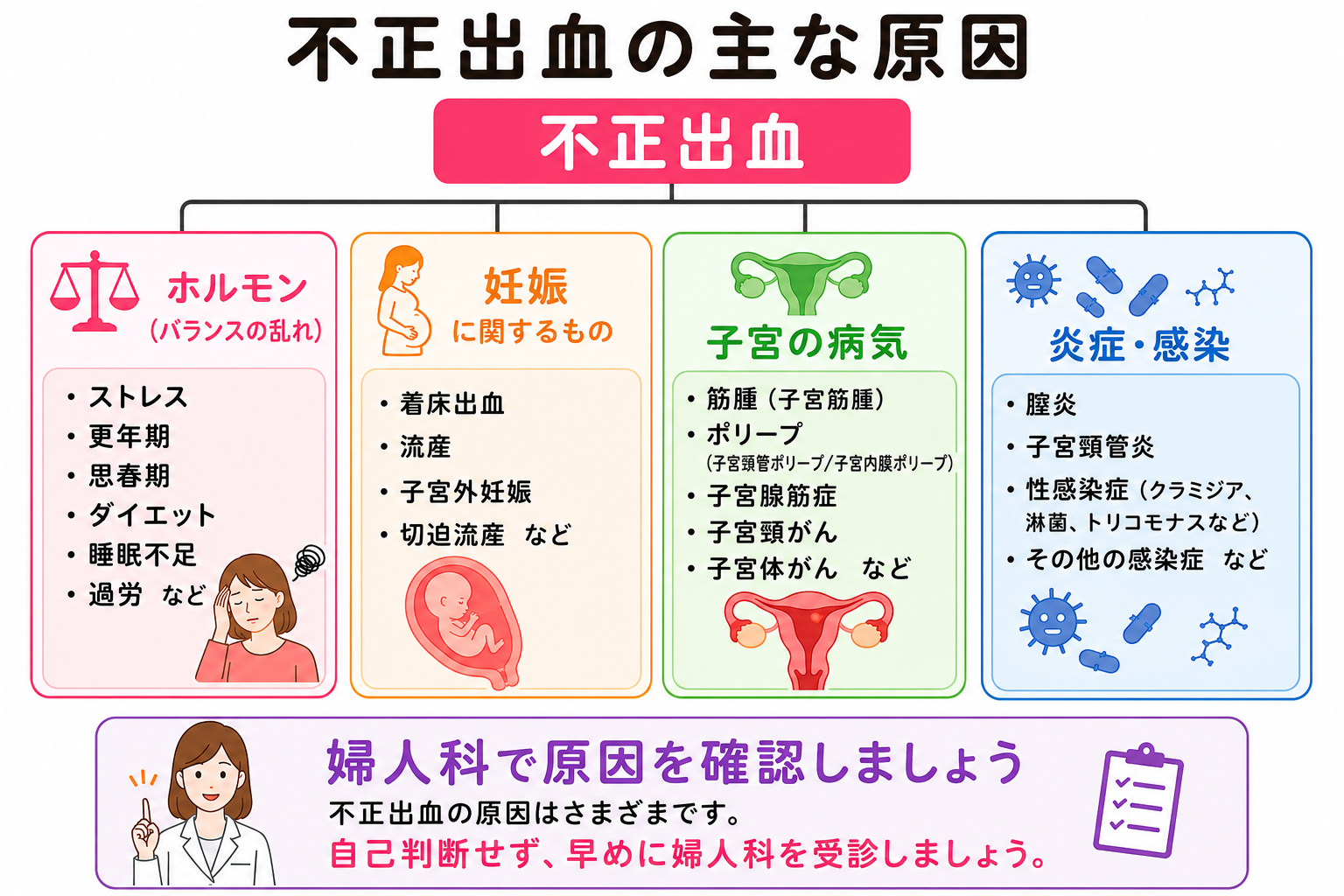
Symptoms alone cannot establish the cause. Broad categories include the following.
Spotting may occur around ovulation or during cycles with irregular ovulation. However, timing alone cannot confirm that bleeding is due to ovulation.
Possible causes include cervical polyps, endometrial polyps, uterine fibroids and inflammation. Testing for cervical or endometrial cancer may also be needed in some cases.
If pregnancy is possible, bleeding needs to be assessed separately from menstruation. Ectopic pregnancy is a particular concern when bleeding is accompanied by abdominal pain.
Bleeding may occur with low-dose combined pills, the mini-pill, Mirena, emergency contraception or hormonal treatment.
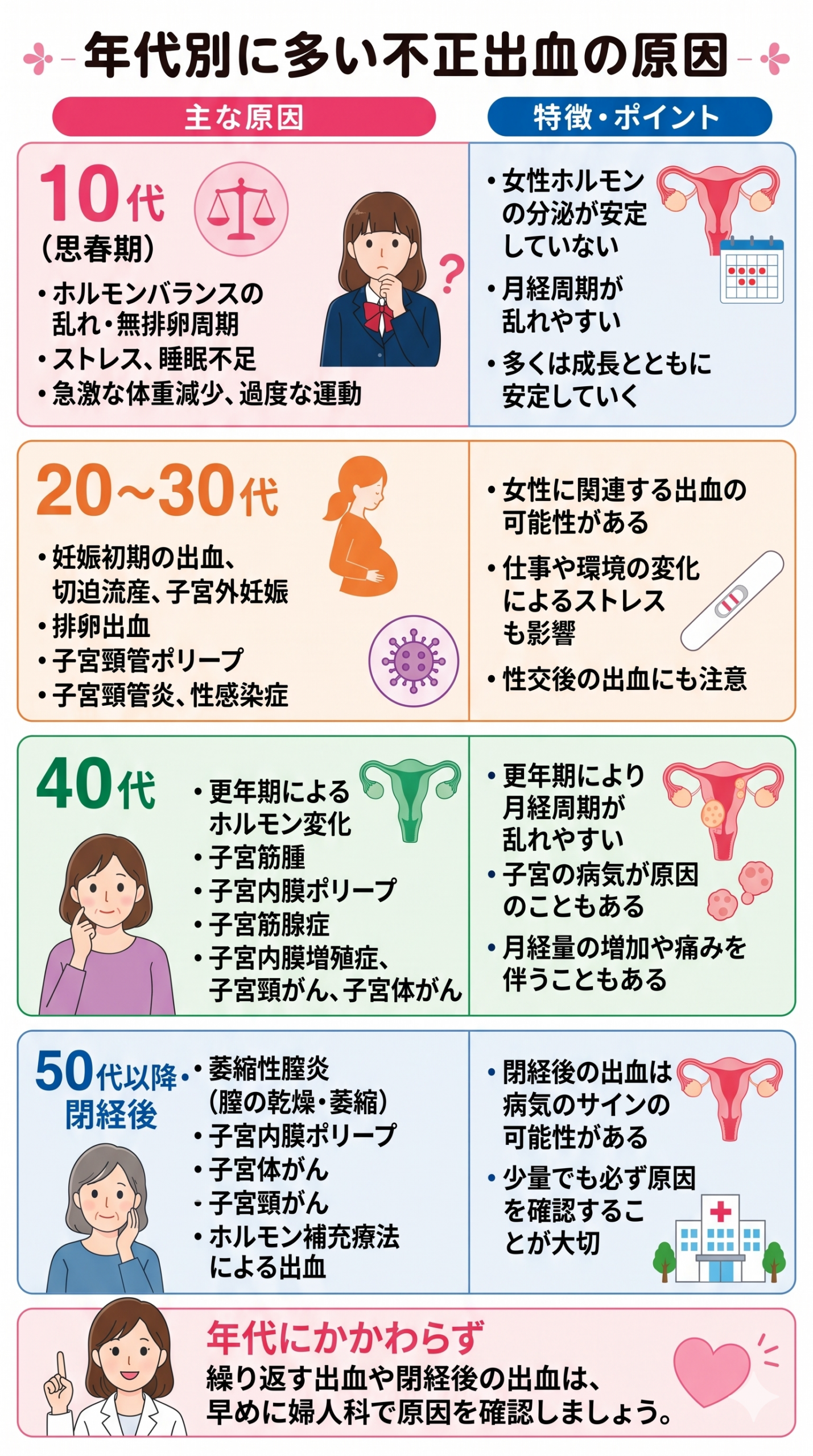
Some causes are more common at particular ages, but age alone cannot determine the diagnosis.
In teenagers, changes while menstrual cycles become established may be involved. During the reproductive years, pregnancy-related bleeding and cervical abnormalities are also considered. From the 40s onward, hormonal changes may contribute. Any bleeding after menopause should be assessed, even if it is light.
Not everyone needs the same tests. We consider the most appropriate approach based on your symptoms, age and other factors.
Please tell us if you are anxious about a pelvic examination or have never had sex. We discuss testing methods while considering the information needed and your comfort. You can seek advice while bleeding, although some tests may need to be scheduled for another time.
We first investigate the cause, then discuss a plan that also considers the amount of bleeding and your pregnancy plans.
Monitoring or medication may be considered depending on your symptoms.
Tests and treatment are tailored to the suspected cause.
Depending on the findings and symptoms, options may include monitoring, a procedure or further tests.
We may recommend referral to an appropriate medical service.
For related information, see our pages on irregular periods and pills and Mirena.
Select a question to open the answer.
Yes.
Even light spotting is worth discussing with a gynecologist if it recurs or you do not know the cause.
Hormonal changes may be involved, but other possible causes include fibroids, endometrial polyps and cervical cancer.
Brown discharge often contains older blood and may be a form of abnormal vaginal bleeding.
A small amount around the start or end of a period may be harmless. However, see a gynecologist if it continues or recurs outside your period.
Yes.
Stress, insufficient sleep and fatigue can disrupt reproductive hormone levels and sometimes contribute to unexpected bleeding.
However, stress is not always the only cause.
It is important to investigate rather than diagnose yourself.
Ovulation spotting is light bleeding associated with temporary hormonal changes around ovulation.
Abnormal bleeding is a broader term that includes ovulation spotting as well as bleeding related to uterine or ovarian conditions, pregnancy and other causes.
Speak with a gynecologist if bleeding is heavy or lasts several days or more.
Hormonal changes during perimenopause can cause unexpected bleeding.
However, we do not recommend assuming it is simply due to perimenopause.
An underlying condition such as endometrial cancer or endometrial polyps may be present, so arrange a gynecological assessment.
Yes.
Bleeding is not expected after menopause.
See a gynecologist to investigate the cause, even if the bleeding is light.
It may be related to age-related changes, but endometrial cancer or another condition can also be responsible.
Possible causes of bleeding during pregnancy include:
• Implantation bleeding
• Threatened miscarriage
• Miscarriage
• Ectopic pregnancy
These are among several possible causes.
Do not assess it on your own. Contact a medical service as soon as possible.
Bleeding after sex may be related to:
• Cervical polyps
• Cervicitis (inflammation of the cervix)
• Cervical cancer
These are among the possible causes.
Consider a gynecological assessment even after a single episode, and especially if bleeding recurs.
Bleeding related to hormonal disruption may sometimes improve on its own.
However, some causes need treatment. Do not assume it will resolve without care; seek an assessment if symptoms continue.
Abnormal vaginal bleeding can be a symptom of cervical cancer or endometrial cancer.
However, abnormal bleeding does not always mean cancer.
See a gynecologist for persistent unexpected bleeding, bleeding after menopause or bleeding after sex so that the cause can be investigated.
Panty liners or pads are commonly used for light bleeding.
In some circumstances, you may be advised to avoid tampons to help reduce the risk of infection.
If bleeding is heavy, seek medical advice promptly.
Bleeding may stop on its own within 1–2 days. However, seek advice if:
• Bleeding lasts several days or more
• Bleeding recurs
• Bleeding increases
• You also have severe abdominal pain or fever
These symptoms warrant prompt assessment.
Depending on your symptoms, tests and assessments may include:
• A discussion of your symptoms and medical history
• A pelvic examination
• Transvaginal ultrasound
• Testing for cervical cancer
• Testing for endometrial cancer
• Blood tests
A combination may be used to investigate the cause.
We explain which tests are appropriate for your symptoms. Please feel free to discuss any concerns.
Not every cause can be prevented, but the following habits can support your health:
• Keeping a regular daily routine
• Getting enough sleep
• Eating a balanced diet
• Getting moderate exercise
• Attending regular gynecological checkups
These can form part of looking after your overall health.
Many people wonder whether their symptoms are significant enough to seek care.
However, unexpected bleeding can be a sign that something needs attention, and finding the cause matters.
We aim to provide considerate care that respects your privacy and helps you feel comfortable discussing your concerns.
You do not need to explain your symptoms perfectly. Please speak with us if any bleeding concerns you.